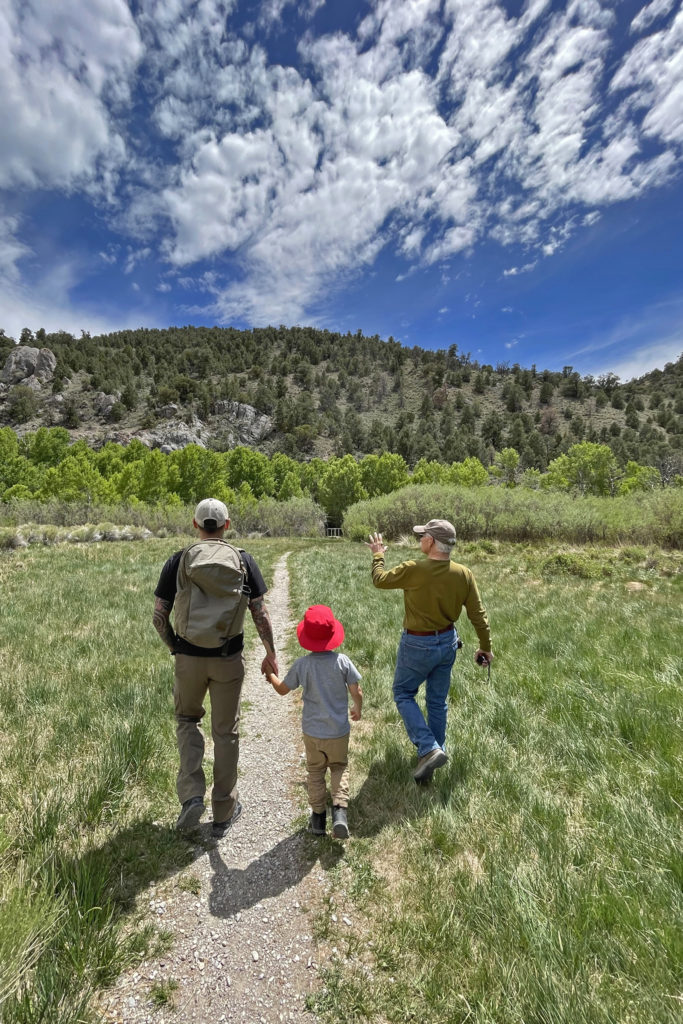
Uncle Brian and Pops taking Tom’s son on a short hike into the small aspen forest along Cave Creek, upstream from Cave Lake. It was breezy and the aspen leaves were performing their ceremonial twisting in the wind, which resulted in a rustling sound. My grandson asked, “Pops, what’s that sound?” I explained that aspen trees were referred to as “quaking” aspens because their flat, broad leaves are attached to long, narrow stems such that they twist in the wind making a quaking or cracking sound. Did you know that aspen stands like these are often created by stems arising from long lateral roots? The result is many genetically identical trees, which in aggregate are called a “clone.” There appears to be some disagreement over which state has the largest clone aspen stand, but one such clone in Utah’s Fishlake National Forrest covers 106 acres and contains an estimated 47,000 stems (see The Gazette article on Utah’s claim).
I know several grandparents who have experienced camping with their children and grandchildren. All of them expressed the joy of passing on the liberating experience of camping to their descendants, whose opportunities for learning appreciation and reverence for nature continue to diminish over time. Getting out of our urban cities to dwell in nature for a few days seems to free our souls. We leave behind our to-do lists and the technology that drives so much or our waking hours, replacing it with the freedom to soak in a deep, satisfying peace. We are released from our daily routines, free to explore and discover without restrictive agendas governing our daily lives.